“Hope” is the thing with feathers —
That perches in the soul —
And sings the tune without the words —
And never stops — at all —
And sweetest — in the Gale — is heard
From “Hope” by Emily Dickinson*
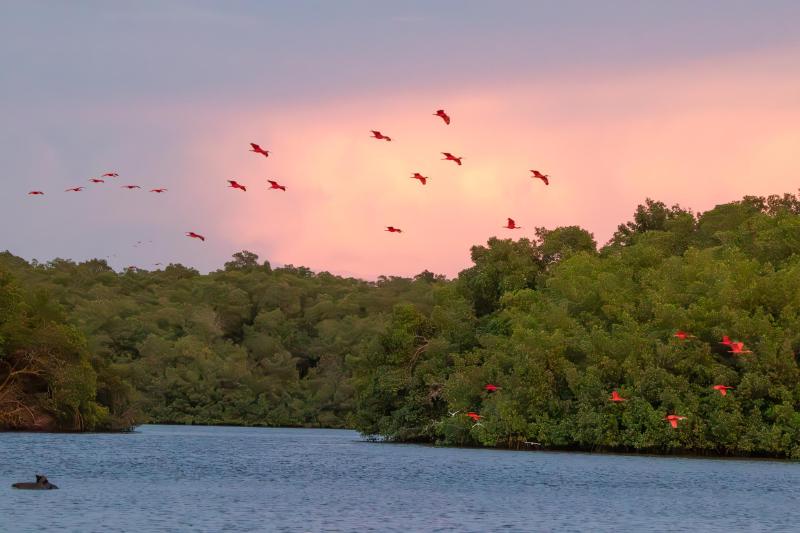
A flat-bottomed wooden boat navigates its way through shallow wetland channels to witness one of Trinidad and Tobago’s natural spectacles. After a pleasant ride and a few snakes, the boat sits moored in the Caroni Swamp. An expectant group sits chatting when suddenly, “Look! De first one!”. As the tour guide exclaims, the group is overcome by oohs, entranced by the brilliant red shape coming into view. It starts with one, two, a handful. Then, a dramatic scene of colours unfolds as Scarlet Ibises return to roost in massive numbers. Swirling flashes of red descend on the mangroves as the birds soar overhead, circling and swooping before they finally come to rest—intense red decoration on the deep green trees. The Scarlet Ibis (scientific name Eudocimus ruber; ruber means red), one of Trinidad and Tobago’s national birds, has much to teach us.
Of course, the Scarlet Ibis shares the colour that makes up most of the T&T flag. Red on the flag is said to represent the “vitality of the land and its peoples”1. But how does the Ibis produce its almost dizzying shade of red? There are two main types of colouration in the animal world: pigmentary and structural colouration. Pigmentary colours are produced when a chemical absorbs some colours (or wavelengths) of light and reflects the rest. The feathers of a Scarlet Ibis contain compounds called carotenoids that are very good at absorbing colours other than red. The light reflected back is therefore mostly red, giving these birds their striking appearance. Carotenoid compounds can also be yellow or orange and are widespread across the animal kingdom. The carotenoids pigments that give the Scarlet Ibis its colour are derived from the crustaceans it eats, e.g., fiddler crabs. These carotenoids are processed in the liver, transported through the blood and incorporated into the growing feather. If development goes normally, a young Scarlet Ibis replaces its grey plumage with brilliant red feathers containing carotenoids. Structural colours are produced when very tiny features, or nanostructures, of an object interact with light, causing some wavelengths of light to be cancelled out and amplifying others. In birds, blue feathers are produced by structural colouration. Therefore, if you were to crush a Scarlet Ibis feather into an extremely fine powder, it would remain red because the pigments would still be present. However, if you did the same for a blue feather, the colour might disappear! This is because you would have disrupted the nanostructures within the feather that produce blue colours. You would need extremely powerful equipment to make this happen but in this hypothetical experiment, that’s what would happen!
Bonus fact: A related form of light-scattering (Rayleigh scattering) of light by nitrogen and oxygen molecules in the atmosphere is what causes the sky to appear blue.
Despite its importance to T&T, the Scarlet Ibis was considered locally extinct as a breeding species by the 1970s. The flocks still came to the Caroni Swamp, but no breeding was observed. While it is difficult to say for sure, the causes probably included poaching and changes to the waterflow caused by development. To add insult to injury, the Scarlet Ibis was added to the list of game species in 1981, for unknown reasons. To appreciate the scale of the hunting, the Forestry Division estimated that around 600 birds, many of them Scarlet Ibises, were shot in the Caroni Swamp on just the first day of the 1983 hunting season. Thankfully, the species had its protection restored in 1986. Despite the challenges, Trinbagonians did not stand idly by and watch the species disappear from our wetlands. At the Pointe-a-Pierre Wildfowl Trust, Molly Gaskin, Karilyn Shepherd, and their team worked on a captive breeding program. The first Wildfowl Trust Scarlet Ibis chick was born on July 11, 19912. This breeding and release program has continued. The Caroni Swamp, which had been a forest reserve since 1936, was elevated to a National Park in 1979 and a large portion of the swamp was declared a ‘prohibited area’ in 1987. By 1995, hopeful reports emerged of Scarlet Ibis again breeding in the swamp3. Since then, the species has continued to nest in the swamp, but it always remains under the threat of poaching. A 1990 publication reported that, “the current number of personnel in the park is hopelessly inadequate, and despite patrolling by a well-trained and enthusiastic staff of wildlife biologists and game wardens, poaching continues in the area”4. Sadly, much of that rings true today. Just like the future of T&T, that of the Scarlet Ibis needs continuous protection and we are often doing too little. We will curry anything, including our future.
The Scarlet Ibis also teaches us that we cannot just look inward and ignore the outside world. In the 1990s, scientists found elevated rates of mutation in mangroves located near Scarlet Ibis roosts. They were producing leaves that lacked chlorophyll, the pigment that makes plants green. When the scientists investigated, they found that the mangroves and sediment surrounding the roosts had high levels of mercury. Even more striking, the mercury was even in the birds’ feathers, but at levels up to 6 times as much as that in the feathers of other species. How could this be? While the ibises migrate to Venezuela periodically, the other birds do not. Some of the Scarlet Ibis’ feeding areas were likely affected by mercury pollution caused by widespread gold mining in Venezuela. Mercury accumulates in body tissues, so as thousands of birds go back and forth between Trinidad and Venezuela over decades, the moulted feathers at regularly used roosts led to an accumulation of mercury. This mercury was absorbed by the mangroves, resulting in mutations. The lesson here is that, while we can protect our own backyard, we live in an interconnected world. Our well-being is that of our neighbour, and theirs is ours.
When Emily Dickinson compared hope to a bird, a “thing with feathers”, she might have had an Eastern Bluebird, or a Black-capped Chickadee in mind. Beautiful birds, no doubt, but she had never seen the glory of the Scarlet Ibis. I think she would be inspired by its beauty and its hopeful story.
How lucky we are.
* Hilariously, when this article was first published in the Trinidad Newsday, it ran with the byline "Emily Dickinson". I never intended a nom de plume, especially not to pretend to the legacy of such a great writer, but here we are.The National Identity Guidelines of The Republic of Trinidad and Tobago ↩︎
https://newsday.co.tt/2017/09/17/the-story-of-the-scarlet-ibis/ ↩︎
A lot of this info comes from Dave Samayah’s thesis, which you can find here ↩︎
Bildstein (1990). Status, Conservation and Management of the Scarlet Ibis Eudocimus ruber in the Caroni Swamp, Trinidad, West Indies. Biological Conservation ↩︎